Press release trends in APAC: The evolving marketing communications landscape
The Asia Pacific (APAC) region stands out as the most dynamic, rapidly evolving, and strategically experimental market when compared to other regions across the globe in terms of press release creation, distribution, and measurement. This is as per the 2025 Global State of the Press Release Report from PR Newswire.
From the rise of AI-driven content workflows to a noticeable shift in planned press release volume, marketing communicators in the APAC are moving differently—and often faster—than their global peers.
Here are some of the key trends, priorities, and challenges in APAC that companies and brands operating in the region should take note of for more effective marketing communications.
1. Corporate growth news up, product announcements down
Press releases often mirror economic reality, and the APAC region’s press release activity apparently reveals a year of transformation. The report points to a notable surge in business-related news releases, including:
- Corporate expansion
- Personnel announcements
- Video news releases (unique to APAC)
Interestingly, new product or service releases dropped significantly in APAC, even though these remain the most common global PR topic. This is one of the clearest signs that APAC brands are shifting away from traditional PR angles and embracing more modern, strategic story formats.
Instead, APAC prioritised “original content” as news. In fact, 56% of APAC communicators plan to focus on original content—thought leadership, survey findings, tips, and educational resources—over product news in the coming year.

The diversity of content being planned in the APAC points to a:
- A maturing content ecosystem
- Strong appetite for educational and authority-building PR
- Regional demand for expertise-driven narratives
- The influence of generative AI, which rewards rich, contextual content
This trend is a clear call to diversify PR angles beyond product updates for brands targeting APAC audiences—or global brands trying to expand into the region— Of course, we believe that product announcements will and should continue to play an important part in the content mix.
2. APAC communications teams quick to adopt AI for press release content creation and SEO/GEO
Across nearly every AI metric in the report, APAC leads the world in adoption. APAC is fastest to adapt press releases for AI-first search
APAC marketing communicators reported:
- The highest adoption of generative AI tools for press release creation (65% overall use)
- The lowest percentage of professionals resistant to AI (just 8% intend not to use it)
- The highest use of generative AI to increase SEO keyword density and long-formoptimization
In fact, a remarkable 58% use AI to craft body copy, compared to 37–40% globally, clearly pointing to a region that is efficiency-driven, tech-forward, comfortable using AI to scale content production and ahead of the curve in answer-engine optimization (AEO/GEO).
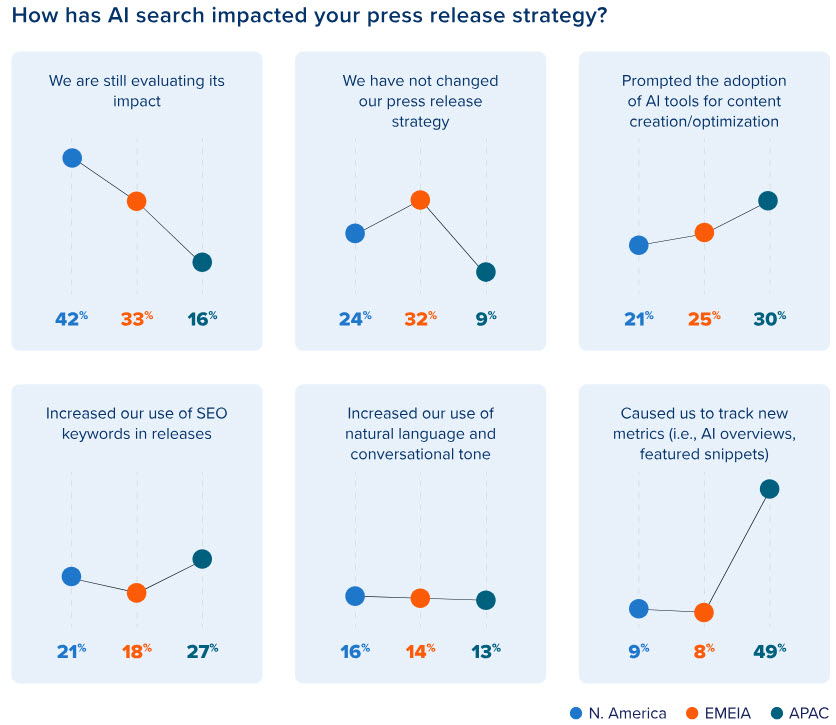
Another key point to note is that AI search is already reshaping PR strategy in the APAC and there is a noticeable shift from just SEO to AEO/GEO:
- Only 18% of APAC respondents said they are “still evaluating” AI search impact
- APAC has the highest percentage tracking new AI-driven metrics
- APAC has the lowest percentage saying they made no strategic changes
As a result, companies and brands operating in APAC must accelerate their AI readiness. Press releases that are written, formatted, and structured for LLM consumption will outperform traditional formats in the region.
3. APAC plans to reduce press release volume
One of the most surprising findings in this press release study was that only 60% of APAC marketing communicators expect to maintain or increase their press release volume, compared to their peers in North America and EMEIA.
This suggests several possibilities:
● Quality over quantity
APAC brands may be shifting toward fewer—but more strategically crafted—press releases.
● Rise of alternative channels
With APAC’s high adoption of video, social content, and AI tools, some brands may distribute news through multimedia-first formats.
● Resource reallocation to integrated campaigns
A strong emphasis on repurposing press release content for video, social, influencer updates, and other formats indicates more holistic communications strategies.
This shift underscores a regional evolution: press releases in APAC must be more purposeful, more strategic, and more multi-channel than ever.
Our view is that rather than targeting a fixed number of press releases, companies must take advantage of every potential news opportunity that presents itself. For small to medium sized businesses, this might mean three to four press releases in a year, while for large companies this could be as much as one to two press releases a month!
4. APAC’s press release distribution strategy: continental, not national/global
Unlike North America and EMEIA—where news releases are often distributed nationally or globally—APAC prioritizes intra-continental targeting.
APAC’s distribution pattern:
- 47% target continent-wide distribution (highest globally)
- Only 16% pursue fully global distribution (lowest globally)
This reflects:
- Diverse markets across APAC
- Heavy localisation needs across languages and cultures
- Business activities often targeted at regional blocs (e.g., Southeast Asia, Greater China, ANZ)
Implications for brands
To succeed in APAC, global companies must adapt to:
- Local-market media requirements
- Regional-newsroom preferences
- Multi-language press release workflows
Emerging markets—Southeast Asia and China in particular—are fragmenting traditional distribution patterns, requiring more nuanced planning.
5. APAC’s content repurposing behaviour: Convert press releases into video content
According to the report, more than half of marketing communications professionals in APAC claim to repurpose press releases into video content, which is significantly higher than in other parts of the world.
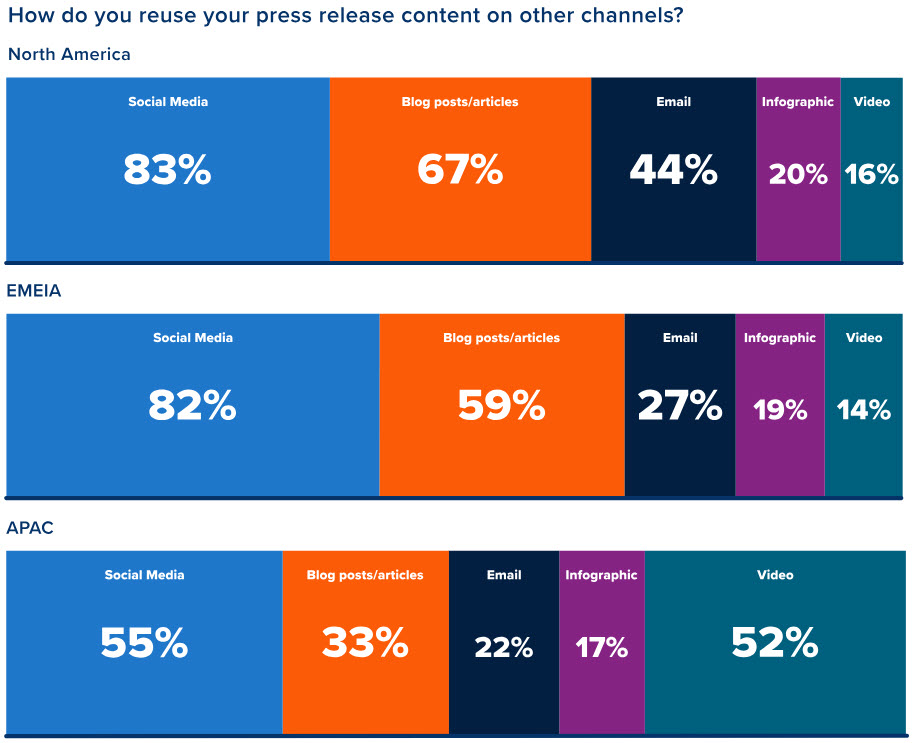
This aligns with broader content consumption behavior in APAC:
- High mobile penetration
- Short-form video dominance (TikTok, Douyin, Reels)
- Younger demographic media consumption trends
- Rapid proliferation of AI video tools
APAC also uses paid placements more frequently
Paid placements—traditionally viewed as a marketing tactic—are more common here, suggesting that the region embraces hybrid PR-marketing approaches faster than others.
For brands, this means:
- Press releases should be designed with repurposing in mind
- Video-friendly story formats perform better
- Multimedia assets (images, logos, infographics) are essential
6. APAC’s PR Challenges: Cutting Through Noise and Feeding LLMs
When asked about their biggest challenges with press releases, communicators globally identified:
- Difficulty reaching the right audience
- Low media pickup
- Standing out amid crowded news cycles
But APAC’s rising concern is unique and future-focused:
Getting press releases to feed LLMs and appear in AI-generated summaries
Because APAC brands are early adopters of AI, they are also the first to actively compete for visibility inside AI search ecosystems, not just traditional media.
This underscores the region’s maturity in:
- Generative engine optimization (GEO)
- Structured data for press releases
- Scannable, LLM-friendly content formatting
7. What Makes APAC PR teams different: A regional identity emerges
APAC is not simply following global PR trends—it is creating its own playbook.
Key traits defining APAC communicators:
| Trait | Evidence from report |
|---|---|
| AI-first mindset | Highest adoption of generative AI for body copy, SEO, translation, ideation |
| Original-content leadership | 56% prioritising thought leadership over product news |
| Multimedia obsession | Highest use of video repurposing |
| Regional targeting | Lowest global distribution; highest continent-focused distribution |
| Efficiency-driven | More releases annually but planning fewer next year |
| Cross-channel fluidity | Strong use of paid placements, social, and integrated promotion |
8. Strategic Recommendations for Brands Targeting APAC in 2025
Based on regional findings from the report, brands targeting APAC should adopt the following:
A. Prioritize thought leadership over product announcements
APAC audiences respond strongly to:
- Expert insights
- Data-backed narratives
- Educational resources
Press releases should demonstrate authority—not just announce activity.
B. Format for AI first
APAC demands AI-ready press releases:
- Clear headline-subheadline structure
- Short paragraphs and scannable key takeaways
- Rich contextual keyword density (for GEO/AEO)
- Strong multimedia signals (logos, images, videos)
C. Integrate video early
With over 50% repurposing releases into video, brands should:
- Produce a short video summary alongside each release
- Optimise visual assets for multimodal AI
- Prioritise mobile-friendly formats
D. Localise for regional variation
APAC isn’t one market—it’s dozens.
Implement:
- Multi-language releases
- Country-specific distribution lists
- Regionally tailored messaging
E. Use press releases as the content foundation
APAC brands excel at amplifying releases across:
Implement:
- Social media
- Paid placements
- Owned channels
- Video
- Journalist databases
A single release can feed multiple touchpoints.
In a world where generative AI engines will play a big part in visibility, the press release isn’t dying—it’s evolving. And nowhere is that evolution more evident than in APAC.
Brands that embrace APAC’s innovative, hybrid, AI-optimized PR strategies will not only thrive regionally—they’ll be better prepared for the future of global communications.
This article is based on a white paper published by PR Newswire on the State of the Press Release. Download the report here.
At On Target Media, we believe that press release writing and distribution continue to be a key part of an effective digital PR strategy. Let us craft the right creation and distribution strategy for you in Singapore or across the APAC. Contact us now!
Recent Articles on SEO, Content Marketing, Digital PR
Lessons from a PR/guest blogging outreach campaign
Recently, we carried out a fairly successful content marketing campaign for a start-up entrepreneur in the health & wellness sector in India. Being very new in the market, the primary objective of the campaign was to create as much visibility for the entrepreneur as possible in relevant channels, while at the same time, maximise opportunities for getting organic search engine (SEO) traffic.
Read MoreHow we helped a Singapore training institute achieve S$1m + in revenues
We have been providing digital marketing services to SMEs for over 20 years, mainly in Singapore and India. One of our recent success stories in helping a training institution grow their business has been in Singapore for a rather niche training services provider focused on the Singapore market.
Read MoreSEO strategy without a content strategy is meaningless
Are you working on creating a SEO strategy that can succeed in the current search landscape? Unless you are starting completely fresh with a new website, ensure that...
Read MoreThe need for a diversified online marketing strategy
In our seven years of existence as a digital marketing agency, we have helped hundreds of small and medium sized businesses get online visibility, primarily through organic...
Read MoreGuest Blogging: Four reasons for its downfall
Guest Blogging was in a rage till a few years back. Website and blog owners used to scour around for high quality and professional guest bloggers. However, lately, their demand has...
Read MorePay Attention: How digital platforms are upending the need for PR
If you are a solopreneur, small and medium sized business or even a start-up, it’s time to pay attention to the reversing fortunes of digital platforms and act quickly.To start with, exit the superhighway.This does not mean that you quit the digital platforms or stop your digital PR efforts. On the contrary, you will need to double down on digital PR ....
Read MoreHow blogging impacts SEO efforts
Often when we speak to a prospect interested in lead generation with digital marketing, we hear the questions, “We should be blogging, shouldn’t we? How many blog posts should we write to be on the top of Google?
Read MoreSee articles on
- SEO
- Content Marketing Tips
- Social Media Marketing Tips
- B2B Digital Marketing Tips
- SEM / Google Adwords